
Risk is not the opposite of safety. It's the only path to it.
Most people spend their entire career running from that sentence. I spent years believing the opposite — that the salary, the title, the employee ID badge meant I had made it. That I was protected.
I wasn't protected. I was just far enough from the edge that I couldn't see it.
The illusion has a very specific shape.
It looks like a direct deposit every 25th of the month. It looks like a job title on LinkedIn that makes your parents proud. It feels like certainty — and certainty, when you've been told the world is chaotic, feels like winning.
But here is what the illusion hides: you are not managing risk. You are concentrating it. Every year you stay in one place, dependent on one organisation, valued for one narrow version of what you can do — you are quietly building the most fragile structure in finance. A single point of failure. Leveraged entirely on someone else's decision.
And that decision will come. It always does. The restructure. The "difficult conversation." The Tuesday afternoon calendar invite with no agenda.
You didn't eliminate risk. You just handed the controls to someone else and looked away.
The statistics are not kind to the story we've been told.
The average person will change jobs twelve times in their lifetime — not by choice, but by circumstance. Entire industries have been hollowed out in a decade. Roles that existed when people started their careers no longer exist when they try to leave. The company that promised stability laid off thirty percent of its workforce in a quarter where it still turned a profit.
Salaried employment was never a guarantee. It was always a probability — and a declining one. The psychological contract between employer and employee that defined the twentieth century has been quietly, systematically dismantled. What remains is the feeling of safety without the substance of it.
That feeling is expensive. It costs you the years you could have spent building something that actually belongs to you.
Now look at the person you were told to be afraid of.
The one who left the job. Who took the contract, started the business, went freelance, built something from nothing, failed, rebuilt, adapted. That person, conventional wisdom says, is reckless. Exposed. One bad month from disaster.
Look closer.
They have multiple income streams where you have one. They have a market-tested understanding of their own value where you have a performance review. They have relationships, skills, and a reputation they own — where you have an access card that stops working the day HR decides it should.
More importantly: they have been tested. They know what a hard month feels like. They know how to cut, adapt, push, and survive. When the shock comes — and it comes for everyone — they have muscle memory. They've rehearsed the fall.
You haven't. And that is the cruelest part of the illusion: it doesn't just delay the risk. It compounds it.
A concept in engineering called a single point of failure.
It refers to any component whose failure would bring down the entire system. Good engineers design around it obsessively. They build redundancy. They stress-test. They assume failure will come and they make sure no single failure is fatal.
We do the opposite with our careers. We call it focus. We call it loyalty. We call it stability.
It is none of those things. It is a single point of failure with a pension attached.
The person who takes risks is not building a fragile life. They are building redundancy. Every new skill is a backup system. Every side project is a circuit breaker. Every failure survived is a load test the system passed. They are, in the language of Nassim Taleb, antifragile — not just resistant to shocks, but improved by them.
The person who avoids all risk is building a structure that has never been tested. And untested structures, when they finally meet the load they were never designed for, do not bend.
They break.
This is not an argument for recklessness.
It is not a manifesto for quitting tomorrow, burning the safety net, and winging it. Risk taken blindly is just chaos. Risk taken deliberately — calculated, incremental, informed — is how every meaningful thing gets built.
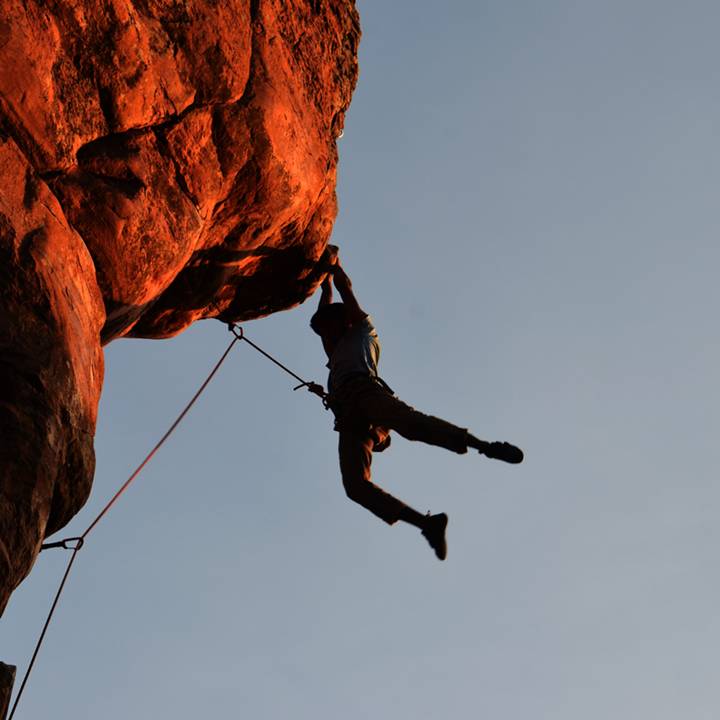
The climber on the hill is not being reckless. They are being methodical. They have studied the route. They have trained for the conditions. They accept that there will be moments where the ground is uncertain beneath them — because they understand that the only way to the summit is through those moments.
They are not brave despite the risk. They are capable because of it.
Real safety is not the absence of risk.
It is the accumulation of survived risks. It is the scar tissue. The reps. The quiet confidence of someone who has been tested and knows — not hopes, but knows — that they can handle what comes next.
You do not build that by staying still. You build it by moving, failing, adjusting, and moving again. By choosing the risk you can learn from over the risk you cannot control.
The person who never risks is not safe. They are simply waiting — exposed, untested, and unprepared — for someone else to make the decision for them.
That decision is coming. The only question is whether you'll be ready for it.
The psychology of the cage you built yourself.
There is a reason people stay. It is not stupidity. It is not weakness. It is something far more sophisticated — and far more dangerous.
The brain is a comfort-seeking machine. Every month the salary lands, the brain registers safety. Every review cycle survived, another neural groove deepens. Over years, the job stops being just a job. It becomes identity. Routine. The scaffolding around which an entire life has been constructed.
And then the scaffolding comes down.
What researchers call "identity foreclosure" — the collapse that happens when a role that defined you disappears — is not a career problem. It is a psychological one. People do not just lose income. They lose the answer to the question who am I. They lose the structure that told them when to wake up, where to be, and whether they were winning.
The person who has taken risks, who has built and failed and rebuilt outside the walls of a single institution, never fully outsourced that answer. They know who they are when the badge stops working — because they have had to know before.
The cage is comfortable. That is precisely what makes it dangerous.
What the risk-takers know that nobody teaches you.
They are not fearless. That is the myth that needs killing first.
Every person who left the salary, built the thing, took the contract, or bet on themselves felt the fear. The difference is not the absence of fear — it is the relationship with it. The risk-taker has learned, through repetition, that fear is information, not instruction. It tells you where the edge is. It does not tell you to stop.
What they also know: risk is not binary. It is not "stable job" versus "chaos." It is a dial. And every deliberate turn of that dial — a new skill, a side project, a conversation you were afraid to have, a boundary you finally held — is a rep. Strength training for the moment when the ground shifts beneath you.
They know that optionality is the real asset. Not the salary. Not the title. The ability to move, adapt, and choose — that is what compounds over a lifetime.
And they know one more thing, the thing nobody prints on a career advice poster: the regret of the risk not taken outlasts the pain of the risk that failed.
Every time.
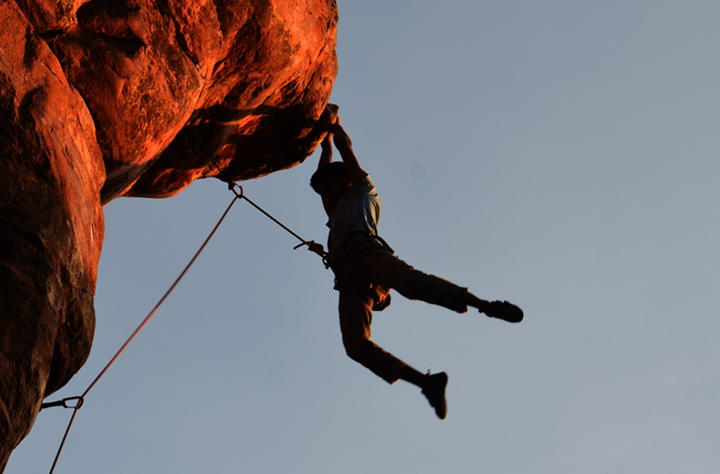
The hill doesn't negotiate.
It doesn't care about your tenure, your title, or how many years you gave to a company that has since forgotten your name. It only asks one question, the same one it asks everyone eventually:
Did you climb — or did you wait for permission?
Risk is not the opposite of safety. It never was. It is the price of admission to the only kind of security that no one can take from you.
Pay it willingly. Pay it early. Pay it on your own terms.
Because one way or another — you will pay it.
Explore more writing on topics that matter.