

Germany's Data Science Hiring Is Different
The demand for data professionals in Germany, Austria, and Switzerland has not slowed down. The 2024 Bitkom survey counted over 149,000 unfilled IT positions in Germany alone — a number that has held stubbornly high through two years of broader tech sector cooling. Swiss financial institutions, Viennese consulting firms, and the dense Mittelstand manufacturing corridor stretching from Baden-Württemberg through Bavaria are all actively hiring data scientists, analytics engineers, and ML practitioners.
The jobs exist. The budgets are approved. The hiring managers are frustrated.
And yet many qualified candidates — especially those from outside the DACH region, or those who learned their craft through the global English-language data science ecosystem — hit a wall of silence. Applications go into portals and disappear. LinkedIn messages sit unread. Phone screens go nowhere. Offers come in lower than expected, with benefit structures that feel foreign and notice periods that feel punitive.
This gap is not random. It reflects structural features of the DACH hiring market that are consistent, predictable, and almost completely absent from the career advice literature — which is written almost entirely for candidates navigating the US tech market, where the rules are different in nearly every way that matters.
This article names the actual rules. Not the official ones — the job descriptions, stated qualifications, and formal process. The real ones: what DACH hiring managers are actually evaluating, what German corporate culture silently expects, and where qualified candidates consistently lose the process through entirely avoidable misreadings.
The Real Market Is Invisible to Most Candidates
Most internationally trained data scientists carry a mental model built from exposure to FAANG hiring, US startup culture, and the companies that write engineering blogs and sponsor tech conferences. Those companies exist in Germany — SAP, Zalando, Siemens, Deutsche Telekom — but they represent a fraction of the actual hiring market.
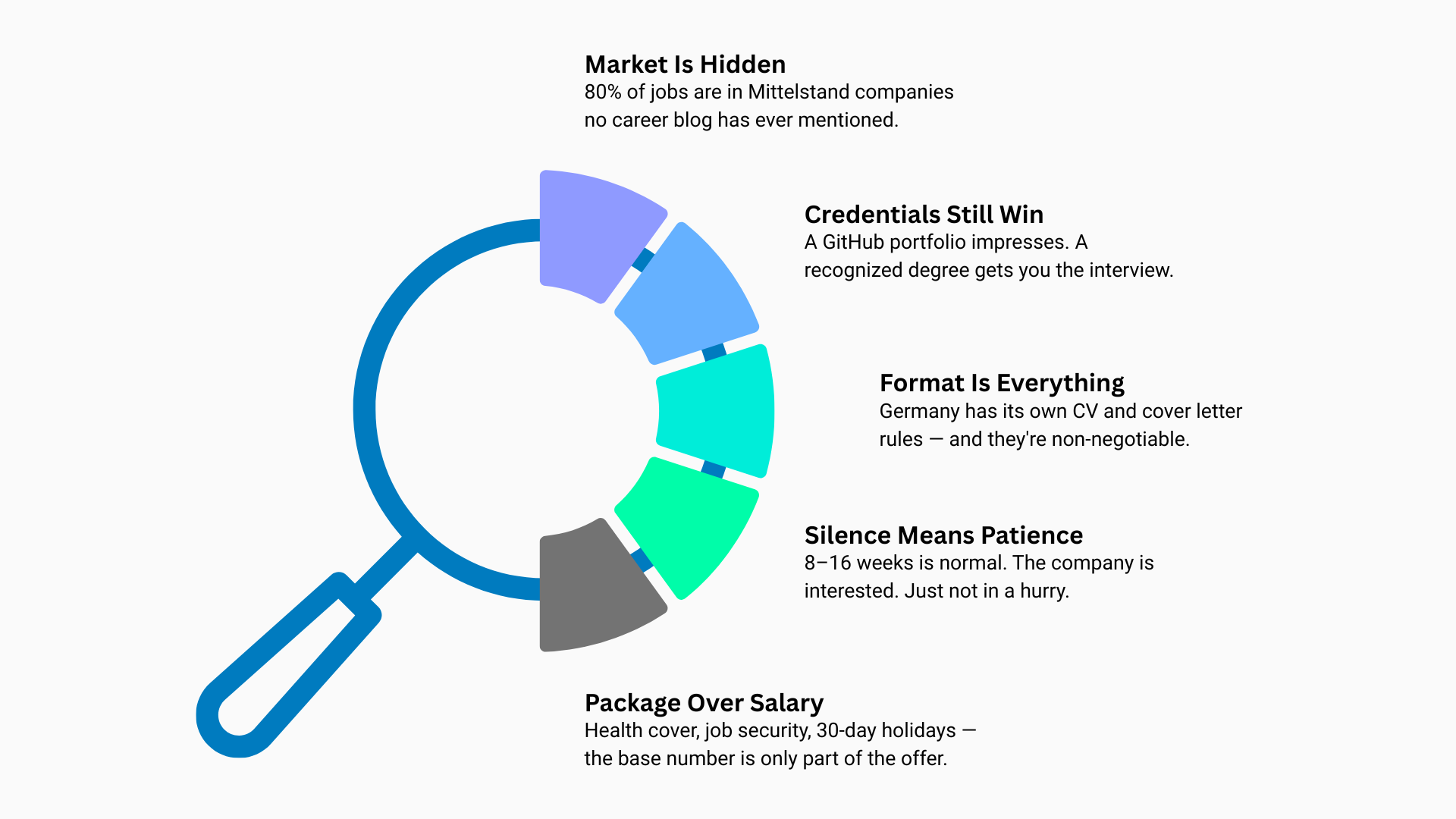
The DACH economy is structurally dominated by the Mittelstand: approximately 3.5 million small and medium-sized enterprises, typically family-owned, often holding global market leadership in highly specific industrial niches. They account for roughly 60% of German employment. A Mittelstand company might manufacture precision aerospace components, produce specialty chemicals for pharma, or build industrial automation systems for automotive production lines. It may be headquartered in a town of 30,000 people in Swabia or Lower Saxony. It has probably been owned by the same family for four generations.
It is almost certainly not on any list of top employers that a data science career blog has ever featured.
These companies are hiring data scientists to solve real problems — predictive maintenance on production equipment, demand forecasting for complex supply chains, quality control optimization in manufacturing, pricing analytics for B2B sales. Problems with genuine economic stakes and serious technical depth.
The candidate who filters exclusively for Berlin tech companies or English-language job postings is ignoring the majority of the actual market. That choice has significant consequences — both for their odds of getting hired and for the quality of work they will actually get to do.
Your GitHub Portfolio Is Not Enough
The portfolio-first strategy — build projects, publish them on GitHub, demonstrate competence through public work — is dominant advice in the English-language data science ecosystem. It is not wrong for the German market. It is insufficient in a way most internationally trained candidates do not anticipate.
German hiring culture, particularly in established companies and the Mittelstand, places real weight on formal credentials. A Studium — a university degree — carries credential weight that a portfolio of self-directed projects cannot fully replace, especially for roles involving client-facing work, professional accountability, or seniority.
This does not mean self-taught candidates or bootcamp graduates cannot get hired. They can, and do — particularly in Berlin's startup ecosystem. But leading with portfolio work and treating formal education as secondary is less effective here than it would be in the US or UK. Candidates with formal degrees should ensure those credentials are prominently and correctly represented, including having degrees evaluated and recognized if they were awarded outside the EU.
The Zeugnisse culture adds another layer. German employers routinely request formal written evaluations from every previous employer — not letters of recommendation in the Anglo-American sense, but structured documents assessing performance, conduct, and the terms of departure. Candidates from markets where this practice does not exist are often unprepared for the request. That unpreparedness reads as disorganization at exactly the moment a candidate is trying to convey competence.
The Application Format Is a Test in Itself
The German application process expects a document with no direct equivalent in most other markets: the Anschreiben.
This is not a narrative cover letter about your passion for data or your cultural fit. It is a formal business letter — structured with address blocks, a formal salutation, and a specific internal logic — that makes a reasoned case for why your qualifications match the role requirements, what you specifically offer this organization, and what motivates your interest in this company in particular. That last part is not rhetorical. German hiring managers read Anschreiben as signals of genuine research and genuine motivation. Generic letters that could apply to any company in the sector are recognized immediately and do not land well.
The formality expectations are real and have not relaxed as much as international commentary suggests. Startups in Berlin and tech-forward companies in major cities have moved toward more informal processes, often requesting only a CV. But in established companies, public sector organizations, and the Mittelstand, a well-crafted formal letter is still expected. Submitting only a CV with a short email signals — perhaps without intending to — that you either do not know the convention or did not care enough to observe it.
The German Lebenslauf (CV) also has specific format expectations. It is structured in reverse chronological order, includes a professional photograph at the top right, includes date of birth and nationality, and is expected to account for the candidate's full timeline without unexplained gaps. The absence of a photograph — standard in Anglo-American applications, where photos are legally fraught — reads as unusual. Unexplained time gaps read as a red flag. Submitting an unmodified Anglo-American CV template adds unnecessary friction to a process where first impressions carry significant weight.
Silence Is Not Rejection
The tempo of German hiring processes differs significantly from fast-moving US tech cycles, and misreading that tempo as disinterest is one of the most common — and costly — errors international candidates make.
A typical process at a mid-size or large company involves an initial phone or video screening, one or two rounds of panel interviews, a technical assessment, and a final conversation that may involve HR, the direct manager, and sometimes a works council representative. The entire process can take eight to sixteen weeks from initial application to offer. This is not unusual. It does not mean the company is lukewarm.
It reflects a deliberate hiring culture that prioritizes consensus over speed.
The Betriebsrat (works council) deserves specific mention because its role is entirely unfamiliar to candidates from markets without codetermined employment structures. German law gives works councils the right to be informed about — and in some circumstances to object to — hiring decisions. In unionized or works-council-active organizations, the hiring decision is not solely the hiring manager's to make. Candidates who interpret this as bureaucratic delay are misreading an institution with legitimate employee interests and real influence over the final outcome.
The panel interview format also carries different norms. German interviewers are often more direct, more skeptical, and less performatively enthusiastic than US interviewers. The absence of warmth during a German panel is not a bad sign. It is a reflection of a professional culture where restraint and seriousness are markers of respect — for the candidate and for the process itself. A demanding, probing interview is usually a good sign.
Salary Is the Last Thing to Negotiate
Germany introduced the Entgelttransparenzgesetz (Pay Transparency Act) in 2017, giving employees in larger companies the right to request median compensation data for comparable roles. Austria has Gehaltsangabe requirements on job postings. Switzerland's revised Gender Equality Act introduced equal pay analysis requirements for larger employers.
In practice, salary transparency has improved — platforms like Kununu and Gehalt.de carry more verified data than they did five years ago, and some companies competing for international talent have started including ranges in job postings.
But candidates who enter salary negotiations expecting US-level directness will be surprised. Salary discussions in German hiring processes are typically deferred further into the process than US candidates expect. The opening conversation about Gehaltsvorstellung (salary expectation) is taken more literally — as a commitment — than the same conversation would be in a US context. Dramatically revising your stated expectation upward between stages is not standard practice here.
More importantly, a German offer needs to be evaluated differently. German employment law provides strong baseline protections — it is genuinely difficult for employers to terminate employees after six months, full health insurance is standard, statutory holiday entitlement is substantial, parental leave is robust, and employer pension contributions change the maths entirely.
A German salary that looks modest against a UK or US benchmark needs to be evaluated against the full package, the cost of living (Munich and Zurich excepted), and the job security protections that simply do not exist in at-will employment markets. Negotiating purely on base salary and treating everything else as secondary is optimizing on the wrong dimension.
What Separates the Candidates Who Succeed
Most failed DACH applications fail before they are submitted. They fail in the research phase — or the absence of one — when the candidate has not understood who the employer actually is, what organizational culture they are hiring into, or whether their background and application materials are even legible in the context that employer is operating in.
The question worth asking before any application in the DACH market is not whether you are technically qualified. For most data science roles, technical qualification is rarely the decisive variable.
The question is whether you understand this specific employer — their industry, their position in the market, the operational problem generating the hiring need, the culture the role will sit inside — well enough to make a case that is specific rather than generic, credible rather than aspirational, and written in the professional register this employer's culture expects.
That understanding is not acquired from the job posting. It requires research. And in the DACH market, where organizational culture is less publicly documented than in the US tech ecosystem, that research requires more effort and more creativity than most candidates invest.
The candidates who invest it are not competing against the same pool as the candidates who do not. That gap is available to anyone who decides to close it.
SB Analysis — This piece draws on SB's editorial research into the DACH labor market: publicly available data, employer surveys, practitioner community discussions, and observed hiring patterns across Germany, Austria, and Switzerland. These are our assessments, not original empirical claims.
Explore more writing on topics that matter.